
Mastering the Art of Collaboration: Principal Investigator and Biotech Dynamics
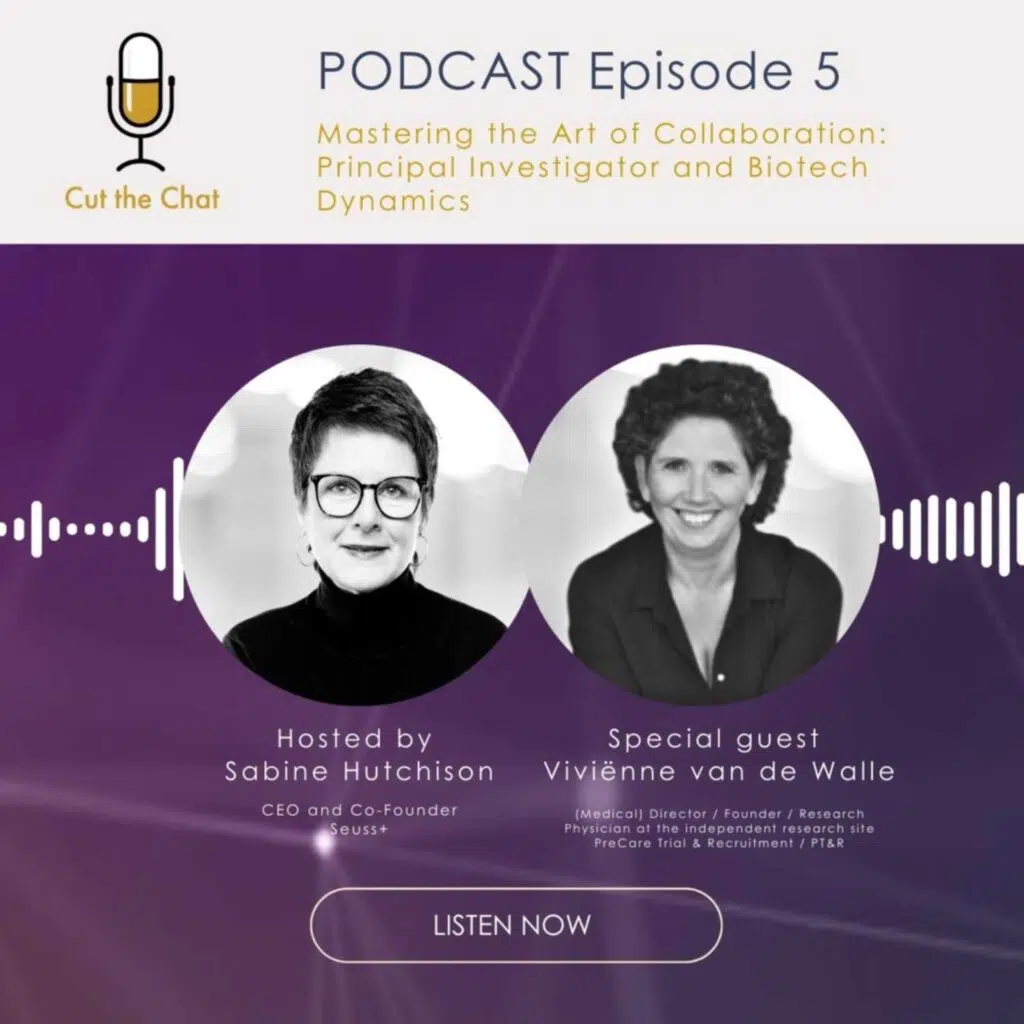
Sabine Hutchison sits down with the incredible Viviënne van de Walle a highly respected principal investigator who brings her wealth of experience to the table, blending clinical research with patient care. As they explore the critical role of communication in successful collaborations, Viviënne shares her insights, stories, and even a bit of humor.
"We don't know what we don't know. We realized there's a lot we didn't know, and thank you for bringing it to our attention."
Featured guest

Viviënne van de Walle
Viviënne van de Walle studied medicine both at the University of Maastricht and at the University of Oxford. In addition to her MD degree she holds a medical research degree in Genetics, Pediatrics and Genetics. In 2004 she successfully defended her thesis for her PhD in Auxology and in 2011 she passed the CPI exam. She has always combined clinical research with patient care and has been a full time principal investigator at independent clinical research sites. She founded and owns the independent research site PT&R (www.ptr.nu) since 2006. Her entrepreneurship is reflected by her skills as thought leader and in consulting, educating and managing at CROs, pharma, nutritional companies and in executive and advisory board functions at eCOA vendors and trade organizations i.e. ACRP, SCRS, TransCelerate, CISCRP and the NVFG. With her PT&R-team she was also the proud winner of the inaugural SPRIA EU award of the SCRS in 2018 . In 2019 she was nominated for the Clinical Trial Europe - Christine Pierre Life Time Achievement Award and in 2020 she was nominated at the 5th World Congress on Advanced Clinical Trials and Clinical Research for Women in Science Awards / Women Scientist. And in 2022 she received the Christine K. Pierre Site Impact Award by the SCRS. She started her research career as a participant in a clinical trial and during the COVID19 pandemic has participated in a vaccine trial for HCP and a virtual predictive COVID infection trial. As a result, Viviënne has a unique perspective of the various sides of the table in clinical research and is eager to share her many years of experience. As she states: “I love it when you pick my brain”.
Full transcript
Host
Welcome back to Cut the Chat: Life Science Insider Podcast. Episode 5: Mastering the Art of Collaboration — Principal Investigator and Biotech Dynamics.
Today's episode is hosted by Seuss+ CEO and co-founder Sabine Hutchison. She's joined by special guest Viviënne van de Walle.
Cut the Chat — Life Science Insider promises to facilitate the conversations you've been dying to hear, and tackle the real crux of our industry's challenges, while addressing the subjects of what we can do as life science leaders to be more successful in a shorter period of time — conversations that might actually help each other when we dare to open up.
So let's get today's episode started, let's get to it, let's cut the chat.
Sabine Hutchison
So, hello and welcome to episode number five of Cut the Chat. Today, our podcast is focused on principal investigators and biotech dynamics — mastering the art of collaboration. And I'm so pleased to welcome Viviënne van de Walle.
She's a highly respected principal investigator who studied medicine both at the University of Maastricht and the University of Oxford. She holds degrees in genetics as well as pediatric genetics. She's always combined clinical research with patient care, and has been a full-time principal investigator at independent research sites. In 2006, she founded the independent research site PTNR, which she also owns. She's a very creative entrepreneur, which is reflected by her skills as a thought leader in consulting, educating, and managing at CROs, pharma, and nutritional companies. Viviënne serves on educational and advisory boards, including ECOA vendors, and trade organizations like ACRP, SCRS, TransCelerate, CISCRP, and the NVFG. She and her team were also the proud winners of the inaugural SPRIA EU Award at the SCRS. And because of her innovative mindset, she's been nominated for numerous awards, including the Clinical Trials Europe Christine Pierre Lifetime Achievement Award and the Fifth Annual Congress on Advanced Clinical Trials and Research for Women in Science Award, and she's received the Christine K. Pierre Site Impact Award from the SCRS.
She began her research career as a participant in a clinical trial, and during the COVID-19 pandemic participated in a vaccine trial for HCPs and a virtual predictive COVID infection trial. As a result, Viviënne has a unique perspective from various sides of the table in clinical research, and she's eager to share her many years of experience. As she said to me — and she also says to her sponsors — "I love it when you pick my brain." Well, that's exactly what we're going to do today: pick Viviënne's brain. I'm so pleased to have you on the podcast, Viviënne, and looking forward to this conversation.
Vivienne van de Walle
Thank you for having me, it's my pleasure.
Sabine Hutchison
Well, we hear — and we know — communication is like the heart of successful collaboration everywhere. Everywhere you hear, communication is key. But what would be interesting to understand from your perspective is how you see communication, how it can be improved, and how critical you see that in creating and fostering relationships — and I think specifically with the focus of working with biotechs as a sponsor.
Vivienne van de Walle
Yes, communication is crucial everywhere in life, and when you're working in clinical research, it's even more so, because you have to be transparent. You have to know each other's expectations, manage those expectations — timelines are crucial. So having a fixed, single point of contact to go to, both from the site perspective, as we have, and then also from the biotech company, makes things easier. Otherwise you're just lost in the jungle, perhaps, of people you have to go to — you don't know who's responsible or who's following up. So that's how I work at my site, especially during the start of a trial — I'll be the first point of contact to go to. The fortunate thing, comparing biotech with large pharma companies, is that large pharma companies have a multitude of people you have to deal with during the conduct, but also during the startup.
Biotech is smaller, and that's why it's often far easier to work with them, because those communication lines are shorter — you know exactly who to go to. But it's all about keeping each other updated, and raising questions when something's not clear, so both know how to move forward and resolve those issues.
Sabine Hutchison
Absolutely. And I think one thing — I mentioned to you earlier, we were recently at BIO-Europe this week, speaking to a lot of biotechs — and this issue is probably not just with biotechs, it's also about patient recruitment. I can imagine the pressure the sites face, and that you face as well, because everyone wants to be prioritized — how can I get my patients in, how can I meet my timelines? I would really love to hear your perspective on this — is there prioritization, what can help encourage speedy recruitment of patients? I realize we could probably talk hours on this, but maybe we can summarize a bit, for some of the companies, on the struggle and this prioritization of patients.
Vivienne van de Walle
Yeah, I mean, there are two things in this question — you're asking about recruitment, and also, what's your sponsor of choice, basically — what's the best collaboration, and where do you want to turn to? I'll get to that later. First, about recruitment: it's not like I need my crystal ball to predict my recruitment, but sometimes you think it's going to be easy and it's going slow, and sometimes it's going fast when you thought it was going to be different. There are so many variables you try to take on board when you're doing your feasibility and signing up for a trial, but then things change. Some diseases are influenced by the season, for instance, like certain skin diseases — so when you start recruitment in early summer, you know it's not going to be a highly recruiting period.
Sabine Hutchison
So the season — the time of year? Yeah, sure, absolutely.
Vivienne van de Walle
But then when you move towards this time of year, you see an increase in patients coming, like, "yes, I do have my active disease right now, can I participate?" So you have to take those things into account. When you get a feasibility, quite often it's only a one-pager. Then when you get through the protocol, all of a sudden the exclusion criteria alone is five pages, and you never took that into account, but they still hold you to whatever prediction you made based on that one-page abstract of the protocol. And there's where communication is so crucial — don't assume that what I said during feasibility still stands when we're starting the trial two years later. The world has changed, the standard of care might have changed, the season has changed, and that means my target might have to be adapted to that.
The other thing is some sponsors think that I can just, I don't know, find patients growing on trees — but it's an active job to find patients. What we do is build a pathway where these patients are actually popping up. To give you an example, we were asked to step in as a rescue site for an alopecia trial — this is with a product for beginning alopecia, when you're losing your hair. They'd been going to academic centers and dermatology clinics, and those are the severe cases, but they were looking for the mild ones. So we said, what if we go to our local hairdressers, and if anybody comes in just talking about "I'm thinning" — and literally, we reached that target in no time, it was just about thinking out of the box, like —
Sabine Hutchison
Right.
Vivienne van de Walle
— where are these patients popping up, and where can I create awareness for them that there's a trial happening they could participate in? And again, that's about communication, because I do need a budget to do this outreach and create awareness. It's not only putting out an advertisement, it's also chasing and calling back — it's very labor-consuming work, and having —
Sabine Hutchison
Right, Viviënne, that's a good point, if I could just interrupt there for a second, because I think that's true — we forget, potentially, when you're far away from the sites, how labor-intensive things are. And if you want a creative site, that needs to be taken into consideration, to also ensure that costs are covered for those kinds of activities as well.
Vivienne van de Walle
The other part — yes. The other part of your question is, how can you be the sponsor of choice, the one people want to work with? And it's all about collaboration, and being felt respected — that they understand that some things do take a lot of time and labor, and that it's implemented in the budget.
What happened to me earlier this year was a sponsor and CRO wrote me an email, and I had to read it two or three times. I stepped out of my office and said to one of my nurses, "I think you have to resuscitate me." She said, "why?" I said, in my 25-year career, I've never had that happen to me. What happened was this sponsor wrote this email saying, "we do understand we signed the contract at the end of 2021, and the world has changed — we're in the pandemic, there's huge inflation, that contract just isn't representative of the cost you're incurring today, and we're at the start of the trial. So here's a new budget." They increased the budget of all the trials I was running with them by 20%, which is a huge impact. And I was talking to another site conducting
Sabine Hutchison
Wow.
Vivienne van de Walle
similar trials, and he said the nurses in his country are on strike over wages, and he said, "I'm not even breaking even with my current contracts anymore, I'm losing money." I told him what happened, and he said, "why doesn't every sponsor take their responsibility? Why do we have to beg for it?" — because when sponsors understand what we're doing at the site, and see the news that wages have to increase, they should automatically come to us and say, "we don't want you to lose money over it." Because next time this sponsor comes back, or the CRO comes back, or I have another CRO coming to me with a protocol that's more or less the same — guess who I'll choose?
Sabine Hutchison
Yeah, it's true. Because it's a partner, isn't it? Going back to what we were talking about, collaboration and communication — it's that partnership. Obviously it's a financial benefit, which helps you, maybe not even to make a lot more profit, but to be able to do those extra things as well. But you feel like you're in a relationship with those types of organizations, then.
Vivienne van de Walle
It is a partnership. Literally a collaboration. You're on the same level.
Sabine Hutchison
Yeah, so true. And that's interesting — so, obviously with some sponsors you work directly. I'm not sure how many biotechs you work with directly versus via CROs. And I think one of the things is that sometimes the biotechs are a bit smaller, and they're very dependent on their partner CROs.
Do you also encourage them to talk to you directly? Can they have that line of communication with you, or does it always have to come via the CRO?
Vivienne van de Walle
Yes, we love it when we have direct contact with the sponsor, the biotech company. We like to be involved at an early stage, when they're doing protocol development, to give our practical input. And I hear more and more sites saying, "if only we'd been sitting at the drawing table, we could have prevented multiple amendments, or made recruitment easier, or had a far better fit to the patient population than we have right now." So it's not about sidelining the CRO, it's about being there and making a protocol that's actually conductable. This isn't to say CROs and sponsors don't have a good idea about it, but they often don't have the full scope of the impact on the site, especially when you're also adding decentralized elements.
Having those conversations, having that input — and sorry to say, but don't just go to the KOL, because he's the scientific person, you need the practical person there too, like the coordinator or the hands-on investigator, to help guide you through the protocol, saying this is feasible or this isn't. And also, from a data-quality perspective — sometimes I see so many things we have to do to a patient that it's literally exhausting for them. Then you have to do a pulmonary test, and it's not going to be representative, because the patient is literally exhausted — these are severe COPD patients, they have to do a multitude of things, and after three hours you still expect them to do a good test. From a theoretical perspective you think, "yes, but we need that data," but then we can help guide how to implement it into a protocol that's feasible to do and still gets you good-quality data.
Sabine Hutchison
That is just such a good point. On our very first podcast, Alan Morgan and I were talking about KPIs, but also focused on the time spent on the protocol early on, and you've just confirmed that again — the time spent looking at exclusion criteria, at the flow of patient visits, all of that can have such an impact. And you mentioned earlier the point of not having to make a protocol amendment — doing all of this in advance can make it so much easier as you move forward. Sometimes there's this pressure of "we have to get it done," but that extra time and those conversations with the sites can have such a huge impact. Do you see that happening — do you experience those early conversations sometimes?
Vivienne van de Walle
It's happening more and more. I'll give you a very recent example: we were conducting a Phase 2 trial, and a lot of things went wrong. I'd known the project manager for many years, even from his previous job, and I eventually picked up the phone and said some of these things could have been prevented if they'd talked to a site — not specifically me, but any site.
He appreciated that I picked up the phone and raised my concerns. About three months later he called me back and said, "I'm now in a new position within this company, and we're rolling out a large Phase 3 program with that same product. I want you at the drawing table — would you be interested in working with us for a whole year?" There were going to be patient representatives in that working group, and another physician from the US as well.
I said yes — for me it was a no-brainer, I wanted to be there and help make this a very good protocol. Into our second or third meeting, this US physician said on the call, "I think I found my twin sister in the Netherlands." I laughed and asked what she meant. She said, "everything that went wrong at your site was going wrong at mine — every solution you or I bring up, we agree on."
Meaning, if it's not working at one site, it's probably not going to work at other sites either. But not all sites pick up the phone — they're scared of losing the business, or the PI isn't involved and it's the coordinator struggling with no direct communication to the sponsor. Some people say we need PIs more involved — I say, involve the ones who are literally conducting the clinical trial.
Sabine Hutchison
Yeah, true.
Vivienne van de Walle
Sometimes it's the coordinator — she's struggling with the e-diary, struggling with getting the patient through all these things and explaining them. I'm a hands-on investigator, and there are a lot of hands-on investigators too, and you can have those at the drawing table. But to have that conversation — literally what this sponsor said during that whole process was, "we don't know what we don't know. We realized there's a lot we didn't know, and thank you for bringing it to our attention during these discussions" — making it into a good Phase 3 program.
Sabine Hutchison
Yeah, that makes total sense. We recently had one of our biotech clients set up weekly calls in the beginning, then taper them, and they've been with the sites more on the medical side, which is of course very valuable. But to your point, it's also good to get the coordinators in, because they're the ones talking to the patients every day, entering the data. So it's important not to forget that — it's not always the investigator who needs to be involved, but also the staff working with patients on site, to set those touch points as well. Really good point.
And you just mentioned the patient, which is of course the most important thing — we hear "patient-centric" everywhere, it's become one of those words that's used a lot. How can biotechs actually think about and create protocols that are patient-centric? Is it what you've said, about talking more with you, or do you have other creative ideas on how to truly make studies patient-centric?
Vivienne van de Walle
First of all, when you're developing something, make sure it's something these patients actually need. One of the biggest lessons I ever learned was from a mother of a child with Duchenne's disease — a muscular disease affecting boys. They thrive in the first years of life, then the muscles deteriorate and they end up in a wheelchair, and eventually — as this little boy taught me — "my heart is a muscle too."
That put it all together for me. What she taught me is she interviewed these boys, asking what was so important to them, because everyone assumed, since they were in a wheelchair, that they wanted to walk, and focused on something that would keep them walking for longer. But when they did the interviews with these boys,
Sabine Hutchison
It does.
Vivienne van de Walle
in their early teens, they knew they were in a wheelchair — they couldn't care less about that. What they wanted was to keep their motor skills in their hands, because then they could move their wheelchair, use a laptop, play computer games. That was their freedom. Their legs weren't working, whatever — but their hands, they needed to be able to rely on for the rest of their lives, because that's what made them independent. So every drug company or biotech that was focused on "these boys have to walk" was missing the whole point of what actually needed to be developed.
Even I've made mistakes assuming certain people wouldn't want injections, that they'd prefer pills. Then, on an obesity trial where patients had to give themselves injections every day, I assumed people wouldn't be willing to do that — until I called some patients in my database and asked if they'd consider it. They said, "if I lose weight, in a healthy way, I'll do it — even three times a day."
So what works for one patient group might not work for another. The same goes for side effects — the same drug, in diabetic patients — the GLP-1 class, which is a very hot topic currently, though we ran trials with it already eight years ago — the side effect of nausea and vomiting was unacceptable for diabetic patients when giving this drug.
Sabine Hutchison
Yep.
Vivienne van de Walle
But to obese patients, they said, "great, because I won't eat and I'll lose weight — I'm happy, I'm not even tempted to eat more." Even a side effect that was counterproductive for one patient group was actually in favor for the other. I couldn't have known that without talking to these patients. Patient centricity is about what they really need, what they want resolved, what they're afraid of,
Sabine Hutchison
Yeah, right.
Vivienne van de Walle
and how much they're willing to bear, how much they're willing to take on. And the only one who can tell you that is the patient, not their physician — because we assume based on what we see, but every patient is different. You have to listen to them, ask them.
Sabine Hutchison
Yeah, yeah — back to the communication piece, right, making sure we're listening and talking to them. So true. Those are some interesting stories, and again, these assumptions we make are dangerous. You mentioned DCT earlier, and also this whole concept of technology — it's everywhere, it's AI, it's here to stay, and it's just going to become more and more evident in the clinical trials you run. But I can imagine, as a site, that can be overwhelming — I'm making an assumption here, but I imagine there must be so many systems to manage, depending on the eCOA, ePRO, all these bits, the data entry. So how do you deal with that? And if you could paint a perfect world for working with technology, what are some important things for you, to make it accessible and easy to harness and use at your site?
Vivienne van de Walle
Yeah, we could talk hours on this topic. First of all, technology isn't an aim in itself — it's a tool to help you conduct a clinical trial and make it easier for patients, that's my belief. And I see the more recent EU guidelines not even talking about decentralized trials anymore, but decentralized elements in clinical trials, which is a very different perspective.
Sabine Hutchison
Yeah.
Vivienne van de Walle
There's a clinical trial, and you can have decentralized elements within it. We've used technology for many years — we've had e-diaries and wearables for years. Even COVID was kind of a pressure cooker where we wanted to do more things remotely. There's a multitude of systems we have to work with — it varies anywhere between 8 to 12 systems per trial, and some sites run between 10 and 20 trials at once. There's overlap, some systems come back, but even with the same service provider, the way you set up the devices might be different for each trial, despite being the same devices — I don't know why, but that's what happens. We have a little joke at my site that we get into a very bad escape room every morning, and we hope we get out by the end of the day, trying to find the lock and the key —
Sabine Hutchison
Oh no!
Vivienne van de Walle
trying to find login details, getting the links to activate, going to the next step, coming back, things not working, or the help desk not working. Yes, it's a challenge, and it can be very time-consuming. We're not technology people, but we're pretty savvy — though I have nurses who say, "I hate it." So we changed the way we work — in the old days, a coordinator had to run a trial from A to Z, do everything themselves. I'm not the only one who's changed that, saying: if you don't like working with the technology side and setting up devices, that's fine, I have someone else on my team who loves it, so she's responsible for the technology on every trial — the same way someone's good at the laboratory and is responsible for everything lab-related.
Sabine Hutchison
That makes sense, yep.
Vivienne van de Walle
Yeah, and there's always a backup, and everybody has to know a bit about everything, but there's one person who's my go-to. I want to know every system, try every system, have access to every system, because I think that's important.
But it's challenging, because a lot of these systems don't communicate with each other — meaning we have to do redundant work, re-entering things over and over. A service provider asked me this week what system or technology I use for that redundant work, and I just looked at her and said, "my fingers and my brain." There's no technology that helps with going redundantly from one system to the other. She laughed and said, "yeah, that makes sense." But I compare it to my iPhone — I Google on Safari that I need a hairdresser, Safari gives me the closest one, I call to make an appointment, or I go to another app that makes the appointment, I go to my navigation system and it gets me there, I can save it to my contacts. Nobody realizes these apps are from different companies, but they're all integrated. So why isn't this happening in clinical trials? Why are we so stuck in silos? Why aren't we sharing the API codes that would let these systems communicate? Once someone integrates all of this, so I just log in once, and I go to my ICRS, my EDC, my drug accountability form, my e-diary, and it's all in one place — that's going to be the winner. That's who we want to work with. System integration, single login — sponsors and service providers know they have to move to that space, because right now it's not helping sites.
Sabine Hutchison
All right, so systems integration is key.
Vivienne van de Walle
It's taking time away from our patients.
Sabine Hutchison
Yeah, that's so true. Times are tight, and having patients wait actually goes back to the point about being patient-centric — we also want to make it easy for everyone to participate in the trial. Really good information. Thank you so much. As you said, I think on each of these questions we probably could have spent a lot more time, but we wanted to try to keep it to 35 minutes — short, tight, and compact
Vivienne van de Walle
Yes, compact.
Sabine Hutchison
and easy for individuals to listen to. So thank you so much — I think these insights are so valuable, and our goal is to share this information out, so people listen and maybe take some of the ideas you've shared today and integrate them, make some changes to make this whole process better for us all, because clinical research is what we all need. We need new medications, we need this all to work, and we need positive collaborations and partnerships — that's what we're all striving for.
Vivienne van de Walle
Yeah, we need to develop new treatment options continuously. Clinical research is fundamental.
Sabine Hutchison
It is fundamental. And it's incredible — this is a bit off-topic from some of the things we've covered, but I'm really curious to hear what made you want to set up your own site.
Vivienne van de Walle
Well, I was working at an independent site, and I wanted to set it up in a way that let me be as patient-centric as I wanted to be. I have time with my patients — that's also why I stepped away from regular healthcare, because it's the insurance companies that actually tell you how many minutes you get per patient. Just explaining things to patients is sometimes already enough to, I'm not saying cure it, but at least give them insight and help them. There's even data out there showing that even the placebo group in clinical trials benefits from participating.
There have been a number of larger network sites knocking on my door asking if I want to join, but the closeness of my team, the way we collaborate, and the way patients respond to us — I said I could never have that with a larger network. Being able to do this, to speak out, to be constructive and try to find solutions — having that freedom, all of these things made me want to do the job I do, and share my experience and move forward. As Christine Pierre, the founder of the SCRS, said, "there's no whinging and whining, just come with solutions" — she planted that in my head, she was a close friend of mine. And fortunately, there are so many companies like yours
Sabine Hutchison
Right.
Vivienne van de Walle
that are willing to listen, share, and move forward, making it a sustainable environment to work in, while being there for patients — and having clinical trials as a treatment option.
Sabine Hutchison
Well, fantastic. And it's wonderful that you speak out, because I know how active you are that way, and that's what's going to help make change — because if we just keep all this information internal and don't share it externally, and let others hear the ideas, we won't see change. So thank you so much for everything you're doing in this space — it's very valuable, for patients and for the companies developing new medications for them. Thanks so much.
I understand you're going to Portugal this weekend for a conference — I hope you enjoy that, safe travels, and I hope you get to enjoy some warm weather too.
Vivienne van de Walle
Yes, I will. But it's always good to see like-minded people and share experience and move forward.
Key takeaways & FAQ
Five Things
- 01 Assign one dedicated point of contact per trial so no one gets lost in communication chains
- 02 Involve hands-on coordinators, not just KOLs, in early protocol design to prevent costly amendments
- 03 Recruit creatively by finding patients where they naturally show up, like hairdressers for alopecia trials
- 04 Increase site budgets proactively when inflation or wage changes make old contracts unsustainable for sites
- 05 Ask patients directly what they want resolved instead of assuming based on physician perspective alone
Frequently asked
Communication improves when both sponsor and site establish a single, fixed point of contact so no one is lost trying to figure out who's responsible. Biotechs tend to have shorter communication lines than large pharma, making collaboration easier. The key is transparency, managing expectations around timelines, keeping each other updated, and raising questions immediately when something is unclear so both sides can move forward together.
Feasibility assessments are often based on a one-page protocol summary, but by the time the actual protocol arrives, exclusion criteria can span five pages, drastically changing recruitment difficulty. Seasonal factors also affect certain diseases, like skin conditions that flare at different times of year. Sponsors need to understand that predictions made during feasibility may no longer apply once trials start years later, since standards of care and conditions change.
Patient-centricity means finding out what patients actually want and fear rather than assuming based on physician perspective. For example, boys with Duchenne's disease cared more about preserving hand function for independence than walking ability, which surprised drug developers focused on mobility. Similarly, side effects like nausea were unacceptable to diabetic patients but welcomed by obese patients trying to lose weight, showing that needs vary by patient population and must be directly asked about.
Sites often juggle 8 to 12 different systems per trial, with some sites running 10 to 20 trials simultaneously, and these systems frequently don't communicate with each other. This forces staff to manually re-enter the same data across platforms repeatedly. The solution sites want is system integration with a single login across all trial systems, similar to how smartphone apps seamlessly connect, which would save significant time for both staff and patients.
A sponsor increased trial budgets by 20% to account for inflation and rising costs after signing contracts in 2021.
Sites typically manage 8 to 12 different technology systems per trial, with some running 10 to 20 trials simultaneously.
GLP-1 class drugs were being trialed as far back as eight years before the current podcast recording.


Liked this episode? Get our monthly LinkedIn newsletter directly to your inbox.
Sign up to stay up-to-date with the business of science, industry news, developing trends, and key insights.